
A dangerous misconception
Counter-drone protection does not mean immediately interfering with a signal.
The term counter-drone system can quickly suggest an immediate technical intervention. For operators of sensitive sites, that view is too narrow. Anyone who intervenes without identification knows neither the aircraft nor its intent, route or the possible consequences of their own response.
The first task is therefore situational awareness. Only a reliable situational overview makes it possible to distinguish authorised internal flights from unknown operations, assess risks and activate defined security processes.
Without identification, decision-makers know neither the aircraft nor its route, intent or the possible consequences of their own response. The first task is to establish a reliable situational overview.
From signal to decision
Three phases that must not be reversed
Modern C-UAS concepts follow a clear sequence. Each phase provides the basis for the next.
PHASE 01
Detection
A flight or supported drone signal is detected within the monitored area.
Without detection, the incident remains a chance visual report.
PHASE 02
Identification
Available information on the type, position, direction of flight and controller is assessed.
Only now can an authorised internal flight be distinguished from an unknown operation.
PHASE 03
Response
Internal measures and the involvement of competent authorities are based on the situational overview.
The response must suit the specific situation and legal framework.
01 DETECTION
Detect a flight or supported drone signal.
02 IDENTIFICATION
Assess available information on the type, position and direction of flight.
03 RESPONSE
Activate internal measures and involve competent authorities on the basis of the situational overview.
What security decision-makers really need
Four answers determine the next action
Security professionals do not need assumptions. They need actionable information.
01 WHAT WAS DETECTED?
A drone, not merely movement
Detection must provide a relevant event so that security teams are not forced to rely solely on verbal reports or brief visual contact.
02 WHERE IS IT FLYING?
Link the route to the protected area
A flight over a car park requires a different assessment from an approach towards an energy facility, production area, warehouse, data centre, club premises or event.
03 IS THE FLIGHT KNOWN?
Reliably distinguish authorised operations
Inspection, surveying or media production may be authorised. A defined approval process prevents unnecessary escalation.
04 IS THERE A RECOGNISABLE PATTERN?
Isolated event or deliberate surveillance
Historical records reveal recurring times, routes and directions of approach. This is what creates a reliable risk picture.
Four essential answers
01 WHAT IS FLYING?
Detect a relevant drone operation rather than mere movement or a brief visual report.
02 WHERE IS IT FLYING?
Assess the route, direction of approach and affected protected area together.
03 IS THE FLIGHT KNOWN?
Distinguish authorised internal deployments from unknown operations.
04 IS THERE A PATTERN?
Document recurring times, routes and directions of approach.
Technically possible does not mean freely deployable
Active interference is not a standard response for private operators.
Jamming deliberately interferes with radio links or navigation signals. In Germany, any use of frequencies generally requires a prior frequency assignment unless a statutory exception applies. The Federal Network Agency expressly lists jammers as an example from its market surveillance work.
For private operators, the consequence is clear. Active radio interference must not be planned as an unrestricted self-help measure. The relevant authority and legal permissibility must be clarified for each specific deployment.
01 Internal protective measures
Secure exposed areas, protect sensitive processes and alert designated personnel.
02 Document the incident
Secure a traceable record of the time, flight path, affected zone and available system data.
03 Escalate according to risk
Depending on the situation, involve internal response teams, site management or competent authorities.
04 Review the process
Assess recurring patterns and make targeted improvements to the protection concept and alert rules.
Transparency is part of professional security advice.
Passive detection does not actively interfere with radio traffic. Nevertheless, the site, data processing, responsibilities and reporting procedures must be professionally assessed before deployment. A device alone does not replace a security concept.
Jamming deliberately interferes with radio links. Private operators must not plan such a measure as unrestricted self-help. The relevant authority and legal permissibility must be clarified for the specific deployment.
01 Secure exposed areas and processes.
02 Document the incident and flight path.
03 Escalate according to risk and the defined process.
04 Examine patterns and improve the protection concept.
Important: A detection device alone does not replace a security concept. The site, data processing, responsibilities and reporting procedures must be planned in advance.
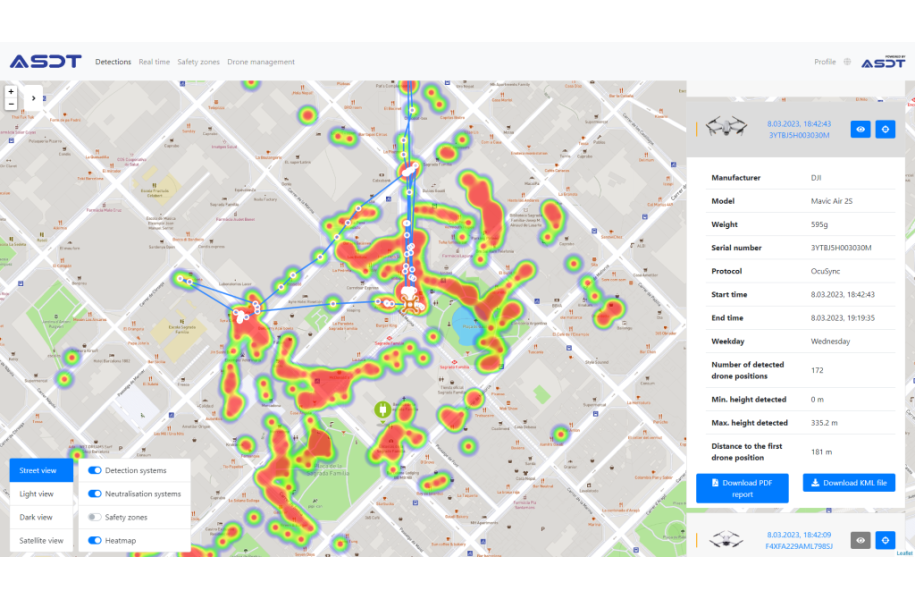
ASDT SENDES
Passive RF analysis provides an actionable situational overview


In brief
Frequently asked questions about counter-drone protection at sensitive sites
What does counter-drone protection mean at a sensitive site?
It includes the detection, assessment and documentation of unknown drone flights, followed by a controlled response. Neutralisation is not automatically part of a private protection concept.
Can a private operator simply jam a drone?
No. Private operators cannot assume that they have unrestricted authority to do so. Active radio interference affects regulated frequency use and must be assessed legally and operationally for each individual case.
Does RF analysis detect every drone?
No. Detection performance depends on the signal, model, protocol and operating mode. For specific risk scenarios, combining RF analysis with additional sensors may be appropriate.
What does counter-drone protection mean at a sensitive site?
Detection, assessment and documentation of unknown flights, followed by a controlled response. Neutralisation is not automatically included.
Can a private operator simply jam a drone?
Private operators cannot assume that they have unrestricted authority to do so. Active radio interference must be assessed legally and operationally for each individual case.
Does RF analysis detect every drone?
No. Performance depends on the signal, model, protocol and operating mode. Additional sensors may be appropriate.
ASDT SENDES for sensitive sites
Understand the site first. Then configure the system.
The protected area, radio environment, deployment duration, authorised internal drones and reporting procedures determine which configuration is suitable. ProFlyCenter assesses these factors before preparing a quotation.
Your direct contact
Do you know what is flying above your site?
Carsten Weber will assess with you whether professional drone detection is suitable for your site and which variant matches your operational profile.
ASDT SENDES for sensitive sites
Understand the site first. Then configure.
The protected area, radio environment, deployment duration and security process determine the suitable variant.
Discover ASDT SENDES View stationary system View mobile systemCW
Your contact
Carsten Weber
We assess whether professional drone detection is suitable for your site and which variant matches your operational profile.
Book a free initial consultationView sources and image credits
Are you interested in this topic? Check it out!