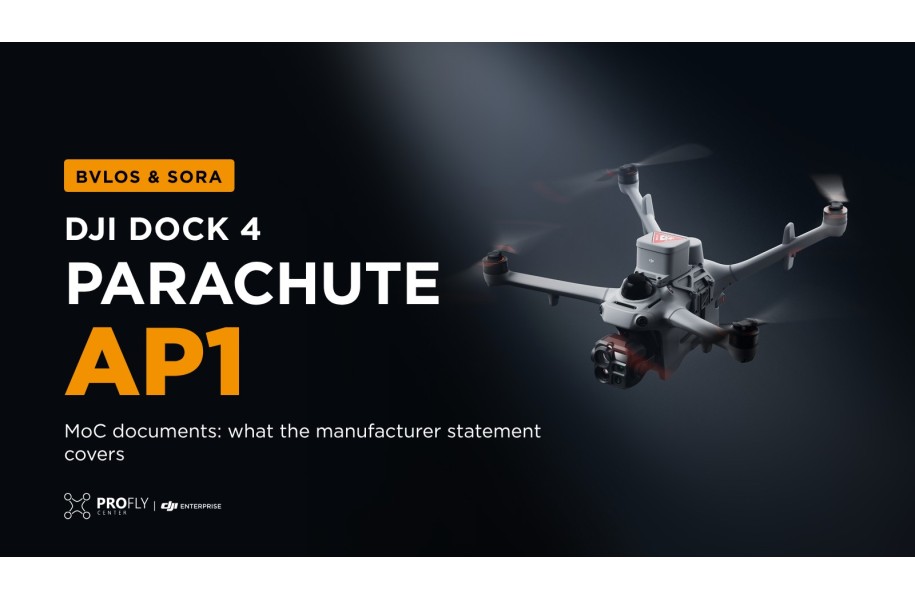
DJI has released new MOC documents for the DJI AP1 parachute on the Matrice 5TD with DJI Dock 4. If you are planning flights beyond visual line of sight (BVLOS), you can use the manufacturer statement in your SORA risk assessment. Flying without a parachute remains possible as long as your concept of operations and your authorisation allow it. The AP1 becomes especially relevant when your route crosses areas where uninvolved people may be present.

The DJI Matrice 5TD with the top-mounted DJI AP1 parachute. Image: DJI
At a glance
- New document package from DJI for Dock 4, Matrice 5TD and AP1 with templates and manufacturer statements for SORA applications up to SAIL II
- Manufacturer statement per MOC Light-UAS.2512 as evidence for the SORA mitigation M2 with medium robustness
- Effective from 35 m altitude: According to DJI, the drone descends under the canopy at less than 6 m/s
- The authority still grants the authorisation. The package makes your application easier but does not replace it
- Everything from one source: DJI Dock 4, training including STS and support all the way to authorisation
What is in the document package for the DJI Dock 4?
DJI provides the evidence that only the manufacturer can supply. What only you as the operator know, you add yourself: site, routes, procedures and the risk assessment for your operation. This means you no longer have to build the technical part of your application from scratch.
| Document | What you use it for |
|---|---|
| Master Document List | Overview of all documents for your application |
| SORA 2.5 template | Basis for your risk assessment, designed for SAIL I and II |
| Operations Manual template | Basis for your operations manual with the Dock 4 content |
| Statement MOC Light-UAS.2511 | Flight Termination System (FTS). According to DJI, it covers manual activation via the FTS web page on a separate device |
| Statement MOC Light-UAS.2512 | AP1 parachute for reducing impact energy (SORA M2) |
| Statement OSO #08 | Manufacturer statement on operational safety objective OSO #08 |
Source: DJI Enterprise, 12 Nov 2026. The templates are versioned, so please check your system configuration and the document version before use.
Real-world example: two track sites, one public crossing

Imagine the tram tracks are being renewed in a city district with 50,000 people per square kilometre. Site management wants to compare aerial images of two construction sections every week. The dock is located at the first section. On its way to the second, the Matrice 5TD is to cross a public footpath and cycle path. The crossing stays open during construction because residents use it to reach their homes and shops.
The track pits are fenced off, but the path between them is not. Pedestrians and cyclists could therefore be directly below the drone during the planned flight and not only if it strays from its route. Your SORA risk assessment must therefore also cover this part of the route.
The AP1 can reduce the consequences of a crash. If the parachute opens in time, the drone descends more slowly and hits the ground with less energy. For the crossing, it is therefore important whether the planned flight altitude is sufficient for effective deployment. DJI specifies at least 35 m. Below that, the parachute will still eject but may not fully inflate. If you can demonstrate the protective effect for your operation, the parachute can enable flights even over higher population densities. On its own, however, it does not entitle you to fly over the public path.
The AP1 parachute in figures: the official data
| Feature | DJI AP1 |
|---|---|
| Effective deployment altitude | from 35 m |
| Stabilised descent speed | below 6 m/s |
| Response time | 600 ms for automatic deployment |
| Automatic deployment | on abnormal attitude or speed and when leaving an area defined in FlightHub 2 (geocaging) |
| Manual deployment | via FlightHub 2 or the FTS page, including in the EU |
| Weight | 107 g (excluding bracket) |
| Protection & temperature | IP55, −40 °C to 50 °C |
| Independent FTS link | yes, with backup power for 30 s |
Manufacturer data from DJI, measured in windless conditions at 25 °C with the Matrice 5TD at a takeoff weight of 3,050 g. Values may vary depending on environment, usage and firmware.
Good to know for your mission planning
- The AP1 can only be deployed once and is replaced completely afterwards. Even without deployment, DJI recommends replacing it three years after activation.
- Plan maintenance at least every six months.
- With the parachute mounted, the Matrice 5TD's ability to detect small obstacles behind and above it is limited.
- Within 10 m of the dock, the AP1 does not deploy automatically as long as the 3D infrared sensing system is working. This is how DJI protects the dock and its surroundings.
What does the manufacturer statement per MOC Light-UAS.2512 demonstrate?
The DJI manufacturer statement per MOC Light-UAS.2512 applies to the combination of Matrice 5TD and AP1. In it, DJI describes the activation modes and operating conditions covered by the statement. If your planned operation matches them, you can submit the document as evidence for the SORA mitigation “M2 with medium robustness”.
One thing is important here: the operational authorisation is granted by the competent authority, which in Germany is the Federal Aviation Office (LBA). DJI provides the documentation but does not guarantee an authorisation. The EU class marking C5/C6 of the Dock 4, Matrice 5TD and AP1 combination does not replace an operational authorisation either.
A note from our practice
For the AP100, the German Federal Aviation Office (LBA) did not accept the DJI documents as sufficient evidence in the cases known to us. For the AP1, we have not yet received any confirmation from the LBA. We have already shared our concerns with DJI.
From documents to daily operations: how we support you
The documents are an important building block. For your DJI Dock 4 to fly safely and with authorisation, you also need the right hardware, trained pilots and a risk assessment that fits your operation exactly. We support you with all three.

DJI Dock 4:
Battery swap in under 25 seconds, up to 59 minutes of flight time and the Matrice 5TD with FTS and AP1 parachute. Secure your pre-order now.

Training & STS:
In our two or three day dock training, your team learns automated VLOS and BVLOS operations. The STS qualification and the DJI Dock certificate are included.

Authorisation & implementation:
We support you with the operations manual and SORA all the way to authorisation. Or we implement your dock turnkey in around four weeks, including installation, training for your team and six months of operational support.
Does your route cross populated areas?
We discuss with you whether the AP1 makes sense for your operation and which documents your application needs. Free of charge and without obligation, on site in Bad Schönborn, by phone or online.
Book a free consultationAs of 19 November 2026. This article does not constitute legal advice. The assessment of the competent authority is decisive.
Are you interested in this topic? Check it out!