In this article you will learn:
1. How the EU regulations classify drone flights into the Open, Specific and LUC categories—and what the A1, A2, A3 subcategories mean in practice.
2. Which minimum obligations always apply (insurance, visual line of sight up to 120 m, LBA registration, appropriate training)—also depending on the drone’s weight and CE class marking.
3. Why, despite EU harmonisation, you must observe national additional rules and geo-zones—plus helpful apps & portals for flight planning.
4. What the CE classes mean for legacy and new drones, which transitional rules apply, and why some older, uncertified models are limited to A3.
5. How the UAS operator ID and Remote ID work, how drones can be identified in flight, and which tools exist (e.g. Drone Scanner).
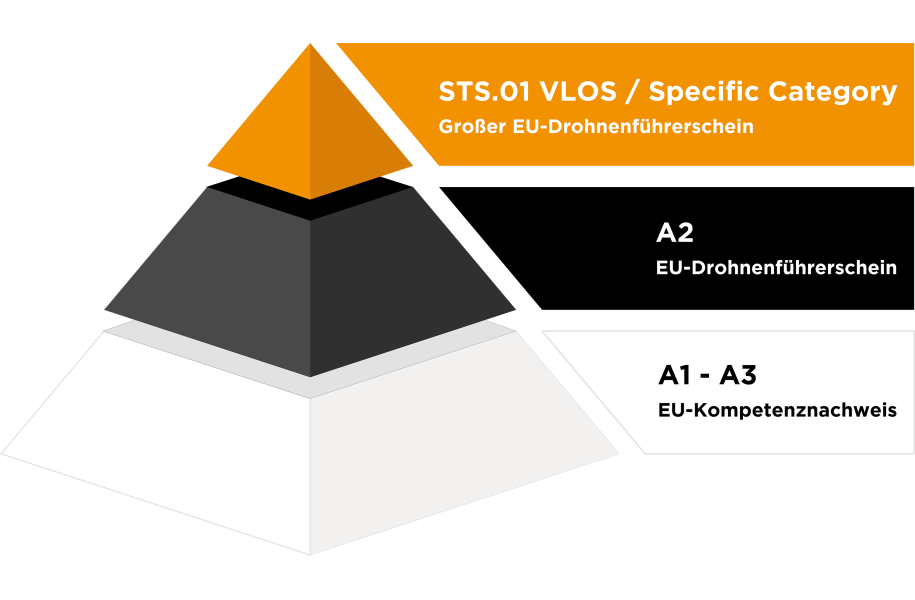
6. Which trainings & certificates exist (A1/A3, A2, STS), how they fit together, how long they are valid, and what matters for refreshers.
7. A compact practical checklist for your next flight as well as paths to webinars and licence trainings, including a discount code.
1. Classification of drone operations: Open, Specific, LUC
The new EU rules divide drone operations into three main categories: Open, Specific and LUC (Light UAS Operator Certificate). For most pilots in Germany, the Open category is relevant. It is subdivided into the A1, A2 and A3 subcategories. Which flights are allowed depends largely on your drone’s CE class marking and take-off weight.
Quick orientation: In A1, very light or appropriately certified drones operate with particularly low ground risk. A2—with an additional certificate—allows flying closer to uninvolved persons under stricter conditions. A3 requires large distances from gatherings of people and built-up areas. A (typical on your website) overview graphic usually shows which models may be operated in which subcategory.
If a planned flight cannot be conducted in the Open category (e.g. because the drone is too heavy, too fast or lacks suitable certification), it must be carried out in the Specific category—often using standard scenarios (STS)—or under a LUC. We cover extensive examples and requirement lists in our STS webinar (Pro Fly Center).
2. Obligations that always apply—regardless of A subcategory & CE class
Regardless of subcategory or class label, several basic rules must always be observed:
- Insurance requirement: Drone liability insurance is always mandatory.
- Appropriate training: Not formally required for up to 250 g without sensors, but clearly recommended by PFC—knowledge increases safety and legal certainty.
- Visual line of sight (VLOS) up to 120 m: In the Open category, maintain VLOS and the height limit.
- Registration with the LBA: UAS operator registration (exception: up to 250 g without recording sensors). Once registered, you receive your UAS operator ID (E-ID).
Important: Pilots—not drones—are responsible for compliance. Plan flights with sufficient lead time and document decisions and approvals.
3. National rules & geo-zones: Harmonised, but not identical
The goal of the EU rules is broad harmonisation across all member states. Nevertheless, national additional provisions exist. A flight permitted in Germany is not automatically allowed in the same way in France, Italy or Poland. Always check the UAS pages of the competent aviation authority in the country concerned.
Practical tips: Many countries provide geo-zone apps or portals that display current flight restrictions and no-fly areas. Example: In Germany, flights are permitted with respect for privacy; in Poland, data-protection rules are more liberal, but there is a flight notification requirement via Droneradar.eu. Before flying abroad, also consult resources such as Drone-made, and keep your certificates handy.
Our lead article on geo-zones (“The nanny is on a break—awareness & personal responsibility”) emphasises: update maps regularly and verify approvals before take-off.

4. CE class marking & legacy drones
The CE class marking (C0–C6 under Regulation (EU) 2019/945) assigns drones to a clear risk profile and links technical requirements with operational allowances in A1/A2/A3. Since 2021, new models have been gradually shipped with CE labels. Older, unlabelled drones fall under transitional rules.
A key consequence from your source: All drones without a CE class label and > 250 g may, since 1 January 2023, only be operated in subcategory A3 (with large distances from people/built-up areas). Some legacy models cannot be retro-certified, for example if they cannot transmit Remote ID. For details and practical Q&A, see the EASA FAQ (116508).
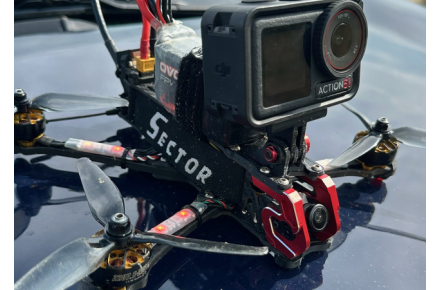
Note on DJI: The manufacturer continues to release new models with CE classification; FPV drones have so far been less directly covered by the regulations, which can complicate certification.

5. UAS operator ID, Remote ID & “Drone Scanner”
After registering with the LBA, operators receive a UAS operator ID (E-ID). It is sufficient to place it as a sticker on the aircraft; it is also stored in the control app (e.g. DJI Fly/Pilot 2). During flight, the drone broadcasts Remote ID data such as position, altitude and speed. The E-ID contains encrypted operator data that only the competent authority can read.
With the free Drone Scanner app (Dronetag), nearby flights can be detected by analysing Remote ID signals. Functionality is being developed continuously; observe the national legal framework.

6. Training & certificates: A1/A3, A2 and STS
The new rules introduced new training paths and EU-wide valid certificates:
- A1/A3 (EU certificate of competency): Online training & exam via the LBA; costs in the two-digit euro range. Registration: lba-openuav.de/einstieg
- A2 (EU remote pilot certificate): Theory in person or online with a designated entity; practical experience via self-declaration or targeted one-to-one coaching. A2 allows closer operations (e.g. reduced distances to uninvolved persons) with additional requirements.
- STS (Specific category, standard scenarios 01/02): A strong option for urban or more complex missions, including heavier drones. Approval effort decreases because scenarios are standardised—but precise requirements for technology, procedures and training still apply.
For deeper practice (e.g. SORA, Operations Manual/ConOps) we offer dedicated workshops and webinars (Pro Fly Center | DJI Academy).
7. Combination, validity & refreshers
Successfully completed certificates remain valid: A1/A3, A2 and STS are typically listed on a single remote-pilot document. If A2 already exists and STS is passed later, you receive a combined certificate “A1/A3 + A2 + STS”. The highest level determines the overall validity—this date appears on the document according to the AMC.
The exact structure of refresher trainings is being finalised. In principle, an STS certificate can be extended within its validity period via a refresher (see UAS.STS-01.20 (3)(b) and UAS.STS-02.020 (10)(b) in Annex 1 to Regulation (EU) 2019/947). Current LBA updates can be found at: lba.de/DE/Drohnen.
8. Pre-flight practical checklist
- Check category & subcategory (model, CE class, weight, mode of operation).
- Verify insurance, registration (E-ID) and certificates (A1/A3, A2, STS).
- Review geo-zones and local rules in the target country/state via app/portal.
- Document the flight profile (launch/landing site, height, distances, emergency procedures).
- Confirm Remote ID & app configuration; keep firmware/software up to date.
- Assess risk (ground/air); prepare/update OM/ConOps/SORA as needed.

9. Further resources & training (with discount)
Deepen your knowledge with our licence trainings (A1/A3, A2, STS) and webinars—including practical examples, checklists and exam preparation. You can find more information in the Pro Fly Center licence trainings.
Discount code for your booking: 127-LD80-38VQ

Are you interested in this topic? Check it out!