In this article you will learn:
1. How to start and fly your drone safely in winter.
2. What to watch for with wind, battery temperature, and shorter flight times.
3. How to set snow exposure and white balance correctly.
4. Which colors and lighting conditions create impressive winter shots.
5. How to use manual focus to get sharp images even in fog or snowfall.

1. Preparation and winter flight technique
In winter, the weather plays a decisive role. Wind, snow, and cold have a strong impact on your drone’s flight characteristics and battery performance. While a DJI Mini 2 can handle wind speeds of 8.5–10.5 m/s, a Mavic 3 withstands up to 12 m/s. Use apps like WINDY or UAV Forecast to check conditions in advance. Also pay attention to your drone’s minimum operating temperature, as batteries discharge much faster in the cold. Keep the batteries warm before you take off.
At takeoff, it’s advisable to let the drone hover in place for a minute so the battery can warm up. Protect your smartphone from the cold as well. Avoid longer flights in very low temperatures and skip Sport mode—frosted sensors can impair obstacle detection. Check battery levels more often than usual and allow enough time to return to the launch point instead of relying on the automatic RTH function.
2. Camera settings for snow and light
Snowy landscapes often challenge the camera: images quickly look underexposed, the snow gray instead of white. Increase exposure—on sunny days by up to two stops, on overcast days +1 EV is usually enough. The AEB (Auto Exposure Bracketing) function captures multiple shots at different exposures so you can choose the best image. White balance is also crucial, as winter photos often have a bluish cast. Set it manually or shoot in RAW for precise post-processing.
Bright, high-contrast colors like yellow, blue, or orange stand out particularly well against white snow and make for vibrant images. Use these effects deliberately to give your photos more depth and impact.

3. Making the most of winter light
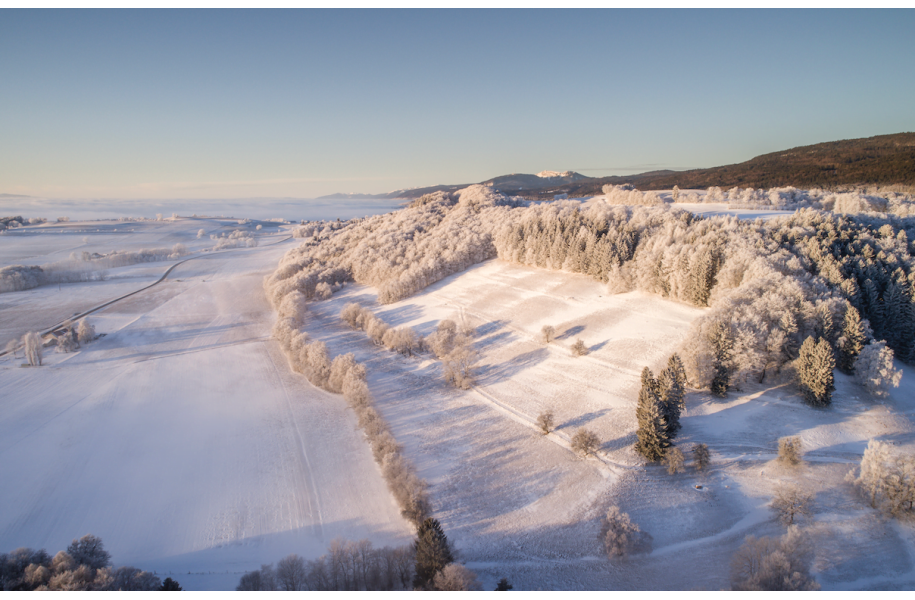
One of winter’s biggest advantages is the light. Because the sun sits lower in the sky at this time of year, you benefit from a longer golden hour with soft shadows and warm tones. Even on cloudy days, the light is pleasantly diffuse, allowing longer shooting windows without being affected by harsh midday sun. Use this unique light to capture atmospheric winter images that stand out from other seasons.

4. Sharpness, focus, and pro tips
Fog, snowfall, or diffuse lighting can make it hard for autofocus to find enough contrast. To avoid soft images, it’s best to switch to manual focus in the DJI app. That way you keep full control over your shots. If you want to capture winter in all its detail, consider the DJI Mavic 3: equipped with a 4/3 CMOS Hasselblad camera, up to 46 minutes of flight time, and intelligent features like ActiveTrack 5.0 or Hyperlapse for breathtaking winter sunsets.
These are just a few tips to take your winter drone photography to the next level. Learn more in our full-day course in Karlsruhe, Hamburg, and Lübeck. You can find more information HERE.
Are you interested in this topic? Check it out!