At a Glance
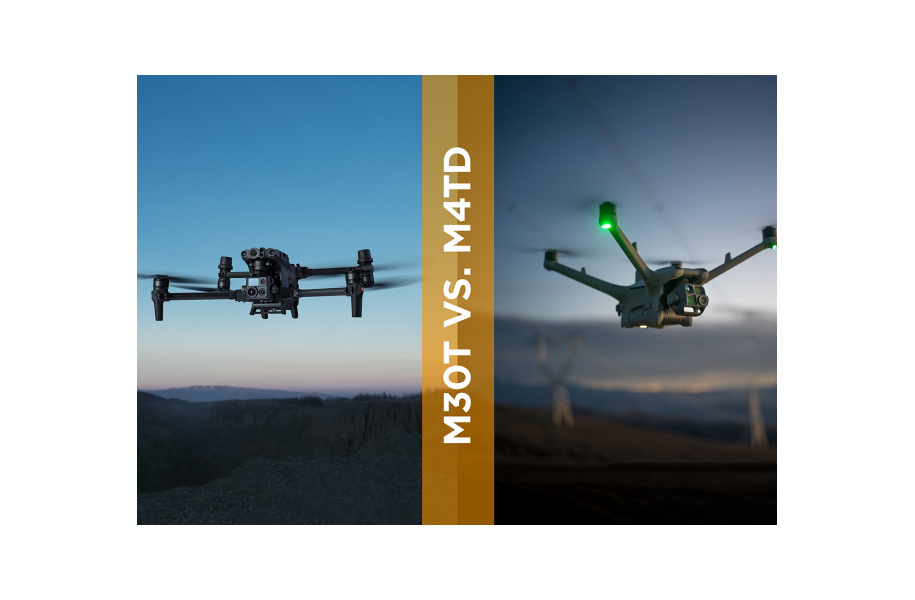
The DJI Matrice 4TD sets new standards in flight time, sensor technology, and weight – and brings additional operational safety thanks to C2 and C6 (with integrated FTS).
The DJI Matrice 30T remains a robust workhorse with a proven platform – ideal where reliability and established workflows count.
| Feature | Matrice 4TD | Matrice 30T |
|---|---|---|
| Battery / Type | 1× 6S Li-Ion (6768 mAh) | 2× 6S LiPo (5800 mAh each) |
| Max. Flight Time | up to 54 min. | up to 41 min. |
| Takeoff Weight | ~1.8 kg | ~3.77 kg |
| Certification | C2 + C6 (FTS integrated) | C2 |
| Protection Class | IP55 | IP55 |
| Temperature Range | −30 °C to +50 °C (with anti-ice propellers) | −20 °C to +50 °C |
| Thermal | 1280×1024 IR (UHR) · 640×512 available · 28× Zoom | 640×512 IR · 28× Zoom |
| Visual Cameras | 3× 48 MP (WW / Mid-Tele / Tele) · 1/1.3" & 1/1.5" | WW 12 MP + Zoom 48 MP · 1/2" |
| FPV View | Obstacle detection visual sensors (also side/backward in FPV) | Separate front FPV camera |
| Laser Rangefinder | 1–1800 m | 3–1200 m |
Flight Time & Power Supply: Who Stays in the Air Longer?
The Matrice 4TD achieves a flight time of up to 54 minutes with only one 6S Li-Ion battery (6768 mAh). The Matrice 30T manages up to 41 minutes with two 6S LiPo batteries (5800 mAh each). In addition to the longer operating time, the 4TD scores with simpler battery handling (one pack instead of two).
Weight & Certification
At only approx. 1.8 kg, the 4TD is significantly lighter than the 30T (~3.77 kg) – a plus for mobility, carrying, and takeoff preparation. Both platforms are C2 certified; the 4TD additionally brings C6 thanks to the integrated Flight Termination System (FTS) – a clear advantage for safety-critical or regulatively demanding missions.
Robustness in Operation
Both drones are protected against dust and splashing water with IP55. The 4TD extends the working range to −30 °C to +50 °C (30T: −20 °C to +50 °C). In combination with anti-ice propellers, the 4TD remains reliably operational even in extreme cold.
Sensor Technology & Imaging
Infrared: Both platforms offer 640×512 px and 28× zoom; the 4TD goes a step further with 1280×1024 px Ultra-High-Resolution – ideal for precise thermography, inspections, or Search & Rescue. Visual: The 4TD combines three 48 MP cameras (Wide-Angle, Mid-Tele, Tele) with larger 1/1.3" and 1/1.5" sensors, respectively. The 30T uses 12 MP Wide-Angle plus 48 MP Zoom (1/2" each). On the 4TD, the obstacle detection serves as FPV view, making side/backward FPV possible; the 30T uses a separate front FPV camera.
Distance Measurement
The Laser Rangefinder of the 4TD covers 1–1800 m, significantly surpassing the 30T (3–1200 m) – advantageous for surveying, target designation, and tactical situational awareness.
Which Drone is Right?
The DJI Matrice 4TD sets new standards in flight time, ** sensor performance**, and weight – ideal for users who demand long operating times, highest image quality, and maximum mobility. It is recommended for inspections in extreme conditions, fire department/rescue operations, and safety-critical operations. The Matrice 30T remains a proven workhorse – robust, reliable, and optimal where established workflows, authority practice, construction inspections, or energy use cases are the focus. For modern operational scenarios without compromises, the 4TD is currently one of the most advanced solutions on the market.
Are you interested in this topic? Check it out!