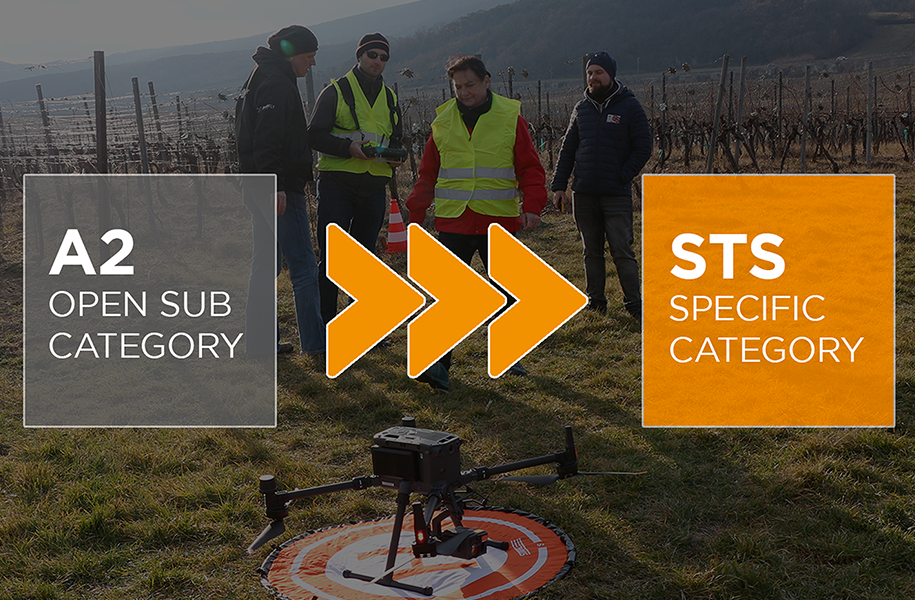
As head of the training department and developer of our courses at Pro Fly Center, it is especially important to me to receive honest feedback not only from drone pilots but also from experienced aircraft pilots. After all, manned and unmanned aviation increasingly meet, and understanding each other is the key to safe and responsible flying.
For this reason, I asked one of our trainees, Paul Aschenborn, himself a PPL(A) pilot, for his open opinion about our training. What began as a short exchange about the A2 certificate developed into an exciting dialogue about aviation responsibility, training depth, and the real benefits of the new STS courses. Paul was so impressed by the approach and the depth of content that a simple plan to get the A2 certificate turned into genuine enthusiasm for the STS program.
His account vividly shows how different perspectives on drone training can be and why it is sometimes worthwhile to go beyond mandatory knowledge.
Below, he tells how he — quite unintentionally — went from being an A2 pilot to an STS trainee and discovered the drone universe from a new, professional perspective.
(Holger Glur)
From A2 to STS – Why It’s Sometimes Better to Learn More Than Just the Basics
I originally just wanted to quickly get my A2 certificate. A click here, a provider there — but the more I searched, the more confusing it became. Everyone promised the best, the fastest, the cheapest. But hardly anyone clearly explained where the exam actually takes place or who ultimately issues the certificate.
Pro Fly Center made the most honest impression: transparent, understandable, and with the possibility to even complete the course through the German Federal Aviation Office (LBA). I found this openness refreshing in an industry where “cheap” often speaks louder than “reputable.”
So I signed up, looked at the A2 materials, and stumbled across a few small mistakes. A quick note to the head of training led to an engaging conversation about details, content, and regulations. He was open, interested, and wanted to correct the points immediately. At one point, he said: “Since you’re already looking so closely, would you like to take a look at the STS course as well?”
Said and done. Suddenly, I was more immersed in the topic than I had planned. What started as “just getting A2” turned into a behind-the-scenes look and eventually participation in the STS training itself.
This led to this article: a personal reflection from the perspective of a PPL(A) pilot, asking what STS really offers and why it may be more than just the next “mandatory certificate” on the to-do list.
PPL(A) Meets STS – Two Worlds, One Goal
As a PPL(A) pilot, you are familiar with the structures, procedures, and discipline of manned aviation. The comparison to the unmanned side was all the more fascinating for me.
Many fundamental concepts are identical: safety, airspace separation, responsibility. The difference is the perspective — once from the cockpit, the other time (or from the ground) on the drone.
Shared topics include meteorology, basic principles of aerodynamics, and fundamental air law.
While PPL(A) focuses heavily on aircraft technology and navigation, STS training primarily conveys operational competence — how to plan, document, and approve drone flights safely.
This overlap makes STS interesting for anyone who already has aviation knowledge or wants to acquire it in a solid manner.
A2, STS, and PPL(A) Compared
| Area | A2 Certificate (Open Category) | STS Certification (Theory) | PPL(A) Private Pilot License |
| Target Group | Recreational and hobby pilots | Advanced or semi-professional drone pilots | Manned aircraft pilots |
| Purpose / Operations | Operation in the open category (C1–C2) | Operation under Standard Scenario STS-01 / STS-02 (e.g., BVLOS, populated areas) | Manned flights in European airspace |
| Authority / Exam | Online exam via designated bodies (e.g., LBA) | Theory and possibly practical part via certified training center | Theoretical & practical exam via aviation authority |
| Scope of Theory | Basics of airspace, meteorology, technology, law | A2 + mission planning, risk assessment (SORA light), flight procedures, technology | Navigation, aerodynamics, meteorology, flight performance, law, human factors, technology, radio communication |
| Exam Format | 40 multiple-choice questions, ~40 min | ~60 multiple-choice questions | 9–12 subject exams, several hours total |
| Cost (approx.) | €25–80 | €250–600 (depending on provider and authority) | from €10,000 (complete training) |
| Validity / Recognition | Valid EU-wide | Valid EU-wide (Standard Scenario recognized across Europe) | EASA license, EU-wide |
| Advantage in Approvals | Limited | Better understanding of application procedures & risk assessment | Comprehensive knowledge as aviation license holder |
| Recommended Prior Knowledge | Basic drone operation | A2 recommended, technical understanding helpful | None, but intensive training required |
Why STS is still worthwhile, even without big ambitions
Not everyone wants to fly commercially or apply for complex operations immediately. Nevertheless, it is worthwhile to look beyond the A2. Anyone engaging with STS — even just the theory part — gains a deeper understanding of how authorities think, how risk assessment works, and what really matters in approvals.
In a world where airspace is increasingly shared, digitalized, and regulated, knowledge is the best buffer.
And even if you continue to fly your drone “only” in the open category — you do it with more confidence and understanding of the bigger picture.
Why looking beyond A2 pays off
In the end, the STS training was for me more than just a formal extension of the A2 certificate. It changed my perspective on drone flying. Behind the cute toy drone — in my case mainly a flying camera — lies an exciting aviation world. A world that gets closer to “real” aviation.
What am I allowed to do? Why do certain rules exist, and how do they interact in practice? These are the questions that help, especially in a world where airspace structures and regulations are becoming increasingly complex. A solid foundation of knowledge is simply invaluable, even if you are (for now) not planning professional missions.
And honestly: I am glad that my short A2 detour went much further than planned. Initially, the question was which provider to choose for A2. That led to a behind-the-scenes look and contacts with people for whom drones and flying are more a calling than a job.
Sometimes you fly further — even at your desk — when the course is right.
(Paul Aschenborn)
About the Author
Paul Aschenborn holds a PPL(A) and now also an STS license (at least the theoretical part).
Through his experience in both worlds — manned and unmanned — he views drone training with a special focus on safety culture, airspace understanding, and decision-making.
His path from A2 to STS began rather by chance — what remained was the enthusiasm for everything that flies and the conviction that solid knowledge is the best co-pilot.
Are you interested in this topic? Check it out!