On October 14, 2025, EASA released the fifth edition of its IAM Hub (Innovative Air Mobility Hub), expanding the center for innovative air mobility with new features. We take a closer look at the specific changes in the following article.
The IAM Hub is a central platform designed to simplify and accelerate the implementation of drone regulations. It also facilitates the exchange of information on drones and electric aircraft. The IAM Hub is intended to support not only the evolving IAM industry but also national and regional governments.
A clear sign that processes are intended to be simplified and made more transparent?
All information can be found on the EASA website under the title: new “solutions” for drone operators and pilots.
Brief overview of the new tools
- EASA Drone Rule Navigator: A regulatory framework for drones that helps unmanned aircraft system (UAS) operators determine the category of their operation and understand the applicable requirements (Link)
- Updated population density maps (Population Density Data): These support the assessment of ground risk for unmanned aviation operations in accordance with the requirements of SORA 2.5, including an explanation of how this data was created (Link)
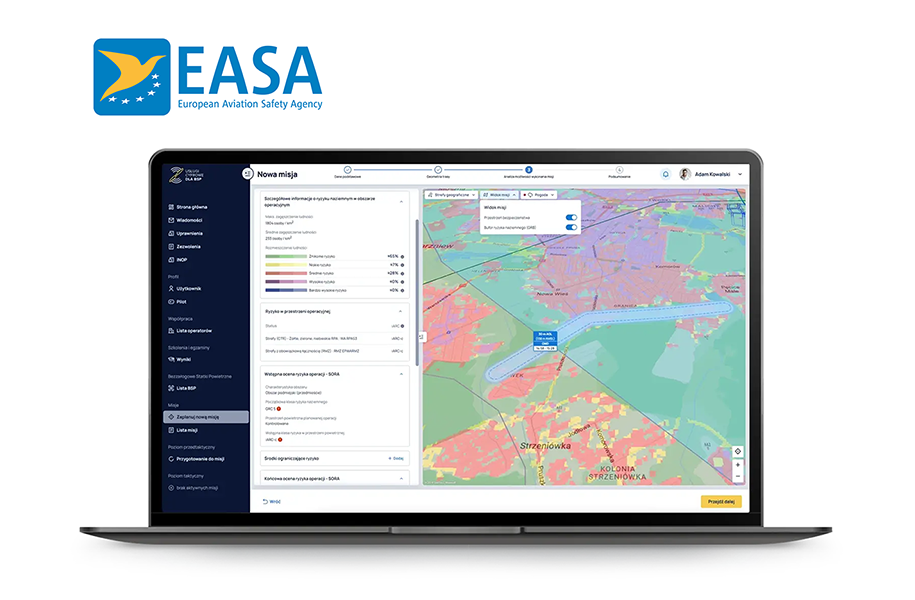
- eSORA module: An automated version of SORA 2.5 in which an operator can select their unmanned aircraft from the EASA database and complete all steps of the SORA process: drawing the flight area (the system automatically determines the operational area and ground risk buffer based on stored drone parameters), automatic calculation of the maximum population density within the operational area and the average density in the adjacent area, identification of mitigation measures, and determination of the SAIL level.
As a result of the input, a draft application for an operating authorization is generated, along with an overview of the supplementary documents that must be submitted to the national aviation authority (NAA).
Currently, eSORA is only available to NAAs. Once released, it will also be made available to operators in the respective country. At present, drone users can already familiarize themselves with the PDF manual (Link) - Updated Drone Economy Dashboard: Contains data on registrations, certificates, and authorizations issued in each EASA Member State (Link)
Currently, the EASA Drone Rule Navigator is only a selection form in which the type of operation is specified and then questions are answered with “YES” or “NO” until the classification of the drone and the associated risks for conducting the operation are determined. Even at this stage, graphics are already displayed, as in this example with a C3 drone in the A3 category.
Here is an example with a C5 drone in the resulting STS scenario. We go one step further and look directly at the evaluation after verification.
The evaluation also includes references to eSORA as well as many useful links to help understand the operation and the associated risks.
Most operations outside the open category end with this notice:
“The operation you have described indicates a high risk. Please use the eSORA module…”
We are curious to see how this develops, but it looks promising.
The eSORA Module
As far as the eSORA module is concerned, it is currently not accessible to users, but only to aviation authorities such as the LBA, our Polish ULC (and other European authorities). The user manual provides initial insights.
We take a first look at the statistical data. There are two options here: the Drone Economy Dashboard and the Density Map (population density map).
Drone Economy Dashboard
The Drone Economy Dashboard provides statistics for countries operating under EASA rules. Let us take Poland as an example. With this CAA, Pro Fly Center enabled the A2 license earlier than other flight schools.
EASA Drone Economy Dashboard
The statistics show for Poland (currently over 403,000 registered operators, over 296,000 A1/A3 pilots, and over 43,000 A2 pilots – source).
In comparison, we look at Germany with: 842 issued authorizations, 680,000 registered operators, 400,000 A1/A3 pilots, 25,000 A2 pilots, but only 1,700 pilots in the STS category (in Poland: over 12,700). Despite the lower number of STS pilots, the market in Germany appears significantly stronger, particularly with regard to the number of issued authorizations (in Poland, this has been barely more than 5–7 per month for months).
Population Density Map under SORA 2.5
Finally, a look at the population density map under SORA 2.5, with the new classification into clusters <5, <50, <500, etc., and a cluster size of 200 × 200 m to cover UAS operations up to 150 m flight altitude.
Thanks to cooperation with all Member States, Copernicus, and the Joint Research Centre (JRC), the IAM Hub now also includes data on population density and land use in accordance with relevant EASA guidelines.
Currently, this cannot yet be used as a practical tool. An information window states:
“THIS MAP IS FOR DEMONSTRATION PURPOSES ONLY” — therefore operationally unusable.
At present, the map only displays static data and does not take into account time of day or population movements. It is simply static information about people potentially residing in the area.
We are curious how these maps are intended to help operators submit applications under SORA 2.5.
EASA Density Map (SORA 2.5)
Innovative Air Mobility (IAM) Hub
The sustainable Innovative Air Mobility (IAM) Hub is a unique digital platform launched by the European Parliament and the European Commission as part of the Drone Strategy 2.0 Flagship 7, with the aim of addressing societal concerns and supporting the safe and sustainable introduction of new forms of aviation. The IAM Hub is intended to facilitate the safe, efficient, and sustainable implementation of innovative air mobility services such as drone operations and electric vertical take-off and landing aircraft (eVTOLs) in Europe.
This includes innovative services such as the inspection of critical infrastructure, medical deliveries, and the transport of passengers using electric aircraft (eVTOLs). The IAM Hub connects various stakeholders within the European system, including cities, regions, national authorities, the EU, operators, and manufacturers, providing them with comprehensive and up-to-date information, guidance, and data on IAM-related topics. The IAM Hub also supports the harmonization of EU rules and regulations, the promotion of transparent and well-founded information on noise and sustainability, and communication of the benefits and impacts of IAM to the public.
Now, finally, we as UAS pilots can also benefit from this — and this is only the beginning. We will continue to monitor the topic and keep you regularly informed.
Are you interested in this topic? Check it out!