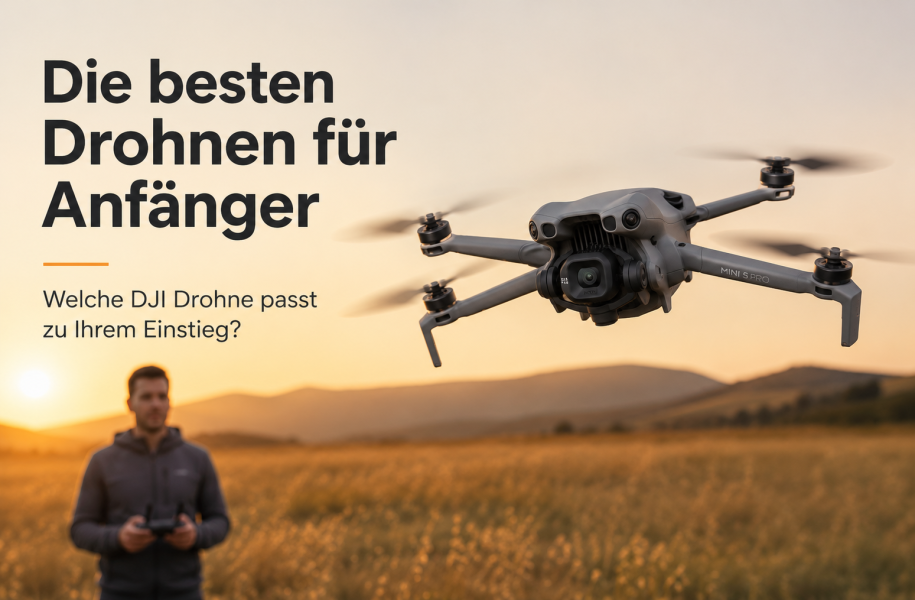
Buying guide for new drone pilots
Best drones for beginners: Which drone should you choose and which license is required?
Are you buying your first drone and unsure where to start? Choosing the right model can be difficult, especially when questions about regulations and required qualifications are added to the decision.
In this article, we present some of the best drones for beginners. The focus is on DJI drones in classes C0 and C1, which can be operated in subcategory A1 of the Open Category.
We also explain in simple terms which training or certificate may be required for the respective operation.
Which drones are best for beginners?
For most people, a first drone should be easy to operate, safe and simple to learn. A stable camera image, automatic safety functions and straightforward setup are particularly useful.
C0 and C1 drones are especially attractive for beginners. They may be operated in subcategory A1 of the Open Category and therefore provide more flexibility and greater possibilities near people than heavier drone classes. The selection is broad and can be matched to the intended use.
The straightforward entry
C0 drones: The easiest way to start
C0 drones may be operated in subcategory A1 without advanced pilot qualifications.
In many cases, basic knowledge of the safety rules, reading the manufacturer’s instructions and registering as an operator are sufficient.
A C0 drone may fly over individual uninvolved persons. Flights over assemblies of people are not permitted.
Which C0 drone should you choose?
DJI Mini 4K: An affordable and capable beginner drone
DJI Mini 4K is a good choice for people who want to start flying drones without spending a large budget. The drone is easy to operate, compact and offers good recording quality for its price.
Its lightweight design makes it well suited to first flights and travel.
Main features and advantages:
- attractive price
- easy entry for beginners
- good 4K image quality
- lightweight, compact and proven design
Disadvantages:
- fewer advanced functions than more expensive models
- no obstacle avoidance sensors
DJI Mini 5 Pro: An advanced drone for beginners and beyond
DJI Mini 5 Pro is intended for users who want to buy a drone for the longer term and begin at a more advanced level. Within the C0 class, the model has very little competition.
The drone offers particularly advanced recording and safety functions while remaining beginner-friendly. It combines straightforward operation with greater creative possibilities.
Main features and advantages:
- extensive camera functions
- intelligent recording modes
- obstacle avoidance sensors that also operate at night with LiDAR support
- strong choice for developing photography and video skills
Disadvantages:
- higher price than basic models
- the number of features may require some learning time
DJI Neo 2: FPV flying and a pocket-sized travel drone
DJI Neo 2 is a lightweight and compact drone that is suitable both for FPV experiences with goggles and as a pocket-sized travel drone.
Its small size makes it easy to take almost anywhere. The quick-start functions support spontaneous flights, sometimes without a conventional remote controller or smartphone.
Main features and advantages:
- FPV-style flying is possible
- many automatic functions
- small and convenient for travelling
- quick start and easy transport
- protected construction for flying in tighter environments
Disadvantages:
- shorter flight time than larger drones
- two-axis camera gimbal only
More performance and possibilities
C1 drones: A combined A1/A3 certificate is required
A1 and A3 are two different subcategories of the Open Category. However, the required theoretical knowledge is covered by one combined EU A1/A3 certificate. This involves a shared online training course followed by one online examination.
How the combined A1/A3 certificate process works
C1 drones may not be intentionally flown over uninvolved persons. An unintended overflight must be limited to the shortest time that is absolutely necessary.
Which C1 drone should you choose?
DJI Air 3 and Air 3S: Advanced technology for beginners
DJI Air 3 is a good choice for users who want to move beyond the Mini series and create more professional footage.
The drone offers a dual-camera system with wide-angle and zoom lenses, very stable flight performance and good wind resistance. This makes it suitable for travel and more ambitious video projects.
DJI Air 3S is the further developed version of Air 3. It is particularly suitable when improved image quality, night recordings and additional safety functions are important. Users who mainly fly during daylight still receive a powerful drone with Air 3.
Main features and advantages:
- dual-camera system for more creative footage
- very good flight time
- stable image and good wind resistance
- advanced tracking and automatic recording functions
Disadvantage:
- higher price than basic beginner models
DJI Avata 2: An FPV drone for beginners and content creators
DJI Avata 2 is intended for users who want to experience FPV flying without having to build their own drone.
It is significantly faster than the DJI Neo series and offers a better camera. Despite its sportier character, it remains comparatively beginner-friendly and enables dynamic FPV footage.
Main features and advantages:
- intense FPV flying experience
- good capabilities for dynamic footage
- intuitive controls
- high level of immersion
Disadvantages:
No clear disadvantages for users who intentionally want an FPV drone.
View DJI Avata 2 in the shop ›DJI Avata 360: A drone with a 360° camera
DJI Avata 360 is intended for users who want to create creative content and record the complete environment around them.
The 360° camera provides greater freedom during editing and makes it possible to select the final framing after the flight. It is particularly suitable for travel, vlogging and online content.
Main features and advantages:
- 360° recordings
- greater creative freedom during editing
- striking and unusual footage
Disadvantage:
- larger amounts of footage and more editing work
Conclusion: There is no single best drone for every purpose
Before buying your first drone, you should consider how you actually plan to use it. For some users, a small travel drone for holiday and family footage is ideal. Others want to experience dynamic FPV flights or produce more ambitious video content.
Anyone who wants an easy start, flexible operation and as few formal requirements as possible should first consider C0 or C1 drones. These models can be operated in subcategory A1 and provide beginners with a high degree of flexibility.
Models from the Mini or Neo series are suitable for travel. Users interested in FPV may consider Neo 2 or Avata. For more demanding video production, the Air series may be the most appropriate choice.
The most important factor is starting with a drone that matches your intended use and encourages you to fly regularly. This makes it easier to develop the fundamentals, safe piloting skills and your own recording style.
Which drone license do you need?
Our overview explains the route from A1/A3 and A2 to STS and individual operational authorizations.
View the drone license overviewFAQ: Frequently asked questions about beginner drones
Do I need a license to fly a drone?
For lightweight C0 drones, including models from the Mini or Neo series, the formal requirements are limited. Operator registration and reading the manufacturer’s instructions are often sufficient. C1 drones require the combined A1/A3 certificate, including online training and a subsequent examination.
Which drone is best for a beginner?
The answer depends on the intended use. DJI Mini 4K is suitable for an affordable and straightforward entry. Users looking for more advanced video functions or a long-term purchase may consider DJI Mini 5 Pro, Air 3 or Air 3S.
Can I fly a drone over people?
C0 drones may fly over individual uninvolved persons. Flights over assemblies of people are not permitted. C1 drones may not be intentionally flown over uninvolved persons, and an unintended overflight must be limited to the shortest possible time.
Can I fly a drone anywhere?
No. Before every flight, you need to check whether airspace restrictions apply at the location. Particular caution is required near airports, cities, critical infrastructure and large public events.
Are FPV drones suitable for beginners?
Yes. Modern DJI models are considerably easier to operate than traditional self-built FPV drones. DJI Neo 2 is suitable for initial FPV experiences, while DJI Avata 2 supports more dynamic flights and more professional footage. To operate legally in the Open Category, the drone must remain within visual line of sight. When goggles are used, support from an observer is generally required.
Is a drone below 250 g worth buying?
For most beginners, a drone below 250 g is a strong choice. C0 drones offer a high degree of flexibility, fewer legal restrictions and a straightforward entry. They are also lightweight, easy to travel with and suitable for holiday footage, family recordings and many everyday applications.
Are you interested in this topic? Check it out!