
Investment based on risk
Not every site needs a system. But every site needs a clear answer.
The investment becomes relevant when likelihood, potential consequences and insufficient response time converge. A rare sighting may be unproblematic for an open storage yard. Above a confidential test production operation, the same flight could constitute a serious security incident.
01 RELEVANCE
What can be identified from the air?
Prototypes, production steps, security zones, people's movements or logistics processes.
02 CONSEQUENCES
What is the cost of an incorrect assessment?
Business interruption, data loss, reputational damage or a delayed security response.
03 ACTION
Can your team act on data?
Only designated personnel, alert channels and documentation turn detection into a security benefit.
What matters is neither an organisation's size nor its legal form, but the potential consequences of an unexplained overflight.
RELEVANCE: What is visible from the air?
CONSEQUENCES: What damage is possible?
ACTION: Who responds to an alert?
Applications with heightened protection needs
Four applications where a lack of airspace awareness becomes a security risk
⚡
Critical infrastructure
Protecting utilities, energy, data processing, transport routes and other sensitive facilities.
🏭
Industry and logistics
Protecting development, production, factory premises, storage areas and transport processes.
🏟️
Clubs, stadiums and events
Early assessment of unknown flights during matches, events and large gatherings.
🏢
Sensitive organisations
Protecting strategic information, technical infrastructure and particularly vulnerable areas.
CRITICAL INFRASTRUCTURE: Protect utilities and sensitive facilities.
INDUSTRY AND LOGISTICS: Monitor processes and large areas.
CLUBS AND EVENTS: Assess unknown flights early.
SENSITIVE ORGANISATIONS: Safeguard information and infrastructure.
Documented system use
Real deployments demonstrate the principle but do not replace a site assessment

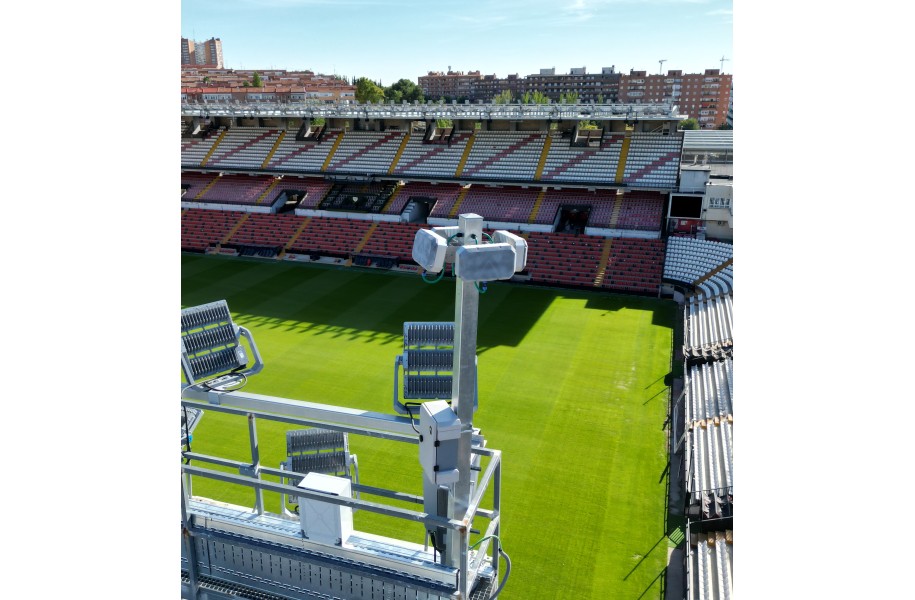
LALIGA STADIUMS
Airspace monitoring during matches
ASDT documents SENDES deployments in stadiums of the Spanish professional league. The aim is to monitor the airspace without interfering with communications or the broadcast of the match.
PETROCHEMICAL PLANT
Continuous monitoring of an industrial complex
Another documented deployment combines stationary RF detection with tiered procedures for perimeters, tanks and control rooms.
Transparency: References demonstrate practical operational capability. They guarantee neither identical ranges nor an identical configuration at another site.
LALIGA
ASDT documents SENDES deployments for airspace monitoring during matches.
INDUSTRY
A documented industrial deployment continuously monitors a petrochemical complex.
References do not replace an assessment of your own site.
Performance without exaggeration
What professional drone detection can and cannot do
THE SYSTEM CAN
Create a situational picture from supported signals
• detect supported drones and radio signals
• display available identification data
• track position and flight path on a map
• provide alerts and event information to designated personnel
THE SYSTEM CANNOT
Automatically eliminate every uncertainty
• guarantee detection of every drone regardless of technology and operating mode
• guarantee maximum technical ranges at every site
• establish the intent of the person controlling the drone beyond doubt
• replace legal powers or an operational alert process
Important for private operators: Active interference with radio links is not a standard function that can automatically be used. Legality, authority and conditions of use must be clarified separately in advance.
CAPABILITIES
Detect supported signals, assess data, track flights and provide alerts.
LIMITATIONS
No guarantee of detecting every drone, achieving every range or determining the pilot's intent.
Active radio countermeasures require a separate legal and operational assessment.
From data to security
Value is only created when data leads to a response
01
Detect
Record the alert and available data.
02
Cross-check
Check your own and authorised flights.
03
Assess
Assess the route, area and risk.
04
Escalate
Initiate internal measures and reporting.
05
Document
Record the incident for follow-up and pattern analysis.
The consequence: Without designated personnel and an escalation path, even correct detection remains operationally ineffective.
01 DETECT: Record the alert and data.
02 CROSS-CHECK: Check your own flights.
03 ASSESS: Assess the route and risk.
04 ESCALATE: Initiate the defined process.
05 DOCUMENT: Keep a traceable record of the event.
Decision-making without sales pressure
Five questions lead to a sound decision
01 Which assets and operational processes are at risk from the air?
02 Have there been sightings, incidents or specific protection requirements?
03 Is permanent protection or a temporary deployment required?
04 What infrastructure and mounting options are available?
05 Who assesses, escalates and documents an alert?
AN HONEST OUTCOME
Saying no can also be good advice.
If the risk, site or response process does not justify an investment, this should be clear before a quotation is issued.
However, if the five questions reveal a significant gap in protection, doing nothing is also a conscious decision. The airspace then remains a documented blind spot.
01 What needs to be protected?
02 What incidents have occurred?
03 Permanent or temporary?
04 What infrastructure is available?
05 Who responds to an alert?
Good advice may also conclude that no system is currently required.
ASDT SENDES at ProFlyCenter
Stationary or mobile. Your operational requirements are what matter.
ProFlyCenter distributes ASDT SENDES in Germany and advises operators, businesses, clubs and event organisers on protection needs, system variants, sites and operational processes.
Your direct contact
Assess the risk first. Then we can discuss technology.
Carsten Weber works with you transparently to assess whether professional drone detection makes sense for your site.
ASDT SENDES at ProFlyCenter
A system tailored to your operational requirements
We advise operators, businesses, clubs and event organisers in Germany on protection needs, variants and sites.
Discover ASDT SENDESView the stationary systemView the mobile systemCW
Your contact
Carsten Weber
A transparent needs assessment before choosing a system.
Book a free initial consultationShow sources
ASDT: Documented deployment in LaLiga stadiums
ASDT: Documented deployment in a petrochemical industrial complex
ASDT: Logistics and production applications
ASDT: Energy and utilities applications
ASDT: Port and airport applications
ASDT: Corporate headquarters applications
Federal Ministry of Justice: Telecommunications Act, Section 228
Are you interested in this topic? Check it out!