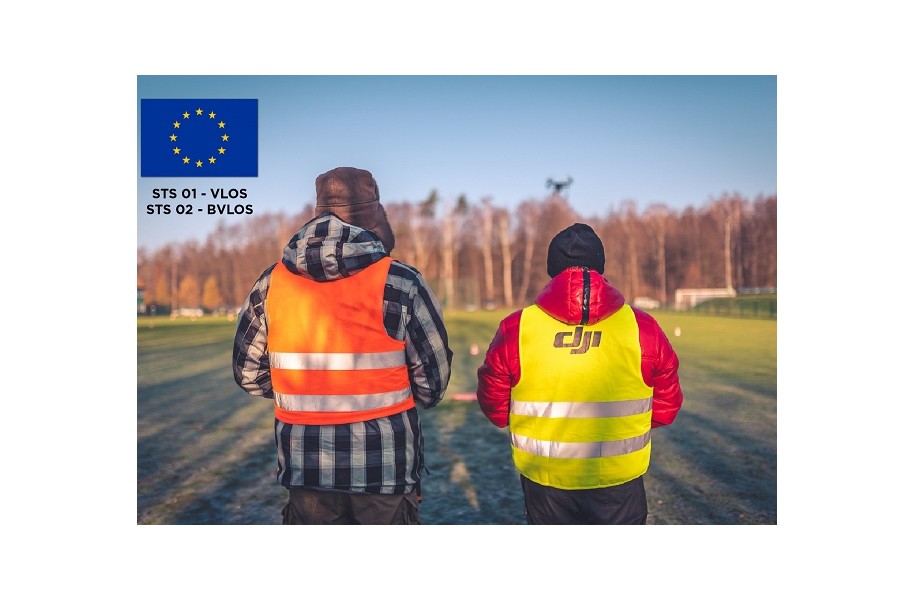
In this article, you will learn:
1. What STS-01 (VLOS) allows (including C5-UAS, populated areas) and what it does not.
2. How to correctly prepare an STS-01 flight (OM, checks, zones, sectors, 5 m/s limit).
3. Which minimum risk buffer values apply for STS-01 depending on altitude/mass.
4. Which UAS are permitted for STS-01 (C5 or C3 + C5-Upgrade Kit).
5. What STS-02 (BVLOS) allows (C6-UAS, 1 km/2 km with observer) and what it does not.
6. How to correctly prepare an STS-02 flight (5 km visibility, GeoCage, sectors, proofs).
7. Which UAS are permitted for STS-02 (only C6).
STS-01 – VLOS: What is allowed?
– UAS up to < 25 kg MTOM (Class C5).
– Flight within the pilot's or observer's visual line of sight.
– Operations in populated areas.

STS-01 – Not allowed
– >120 m above the take-off point or vertically relative to the slope in uneven terrain.
– UAS with > 25 kg MTOM.
– BVLOS.
– Transport of dangerous goods.
– Controlling more than one drone simultaneously.
– Control from a moving vehicle.
– Transfer of control between pilots.
STS-01 – Execution (Checklist)
– Create Operations Manual (OM); all pilots trained & compliant.
– Mark UAS with operator number; conduct pre-flight check.
– Check weather against UAS limits & capabilities; check/adhere to airspace restrictions.
– Carry training/online test confirmation (paper/PDF).
– Analyze the environment (uninvolved persons, sensitive infrastructure).
– Plan area in 3 sectors: geographical flight space · hazard area · ground risk buffer.
– Inform people in the operational area in advance.
– Fly at ≤ 5 m/s (≈ 18 km/h).
– Only use C5-UAS or C3 + C5-Upgrade Kit.
STS-01 – Minimum Ground Risk Buffer Sizes
– < 10 kg MTOM: Altitude 30/60/90/120 m → Buffer 10/15/20/25 m.
– > 10 kg MTOM: Altitude 30/60/90/120 m → Buffer 20/30/45/60 m.
Which drone for STS-01?
Class C5 is required. Alternatively, a C3 drone can be upgraded to C5 with certified accessories (e.g., parachute/kill-switch).
More on training/exam: STS Theory (VLOS/BVLOS) · STS Practical.
STS-02 – BVLOS: What is allowed?
– UAS up to < 25 kg MTOM (Class C6).
– Overflight of sparsely populated areas.
– Automatic BVLOS flights up to 1 km (without observer).
– Automatic BVLOS flights up to 2 km (with observer; UAS ≤ 1 km to the nearest observer).

STS-02 – Not allowed
– >120 m above the take-off point or vertically relative to the slope in uneven terrain.
– UAS with > 25 kg MTOM.
– Overflight of densely populated areas (cities).
– BVLOS >1 km without observer / >2 km in general.
– Flights with visibility < 5 km (Pilot/observer must be able to spot manned traffic in time).
– Operation without GeoCage programming.
– Controlling more than one drone; transfer of control to other pilots.

STS-02 – Execution (Checklist)
– OM available; team trained & compliant.
– Mark UAS with operator number; conduct pre-flight check.
– Ensure minimum visibility of 5 km; program GeoCage.
– Check/adhere to airspace restrictions; carry training proofs (paper/PDF).
– Analyze the environment (uninvolved persons, infrastructure).
– 3-sector planning: geographical flight space · hazard area · ground risk buffer.
– Only use C6-UAS.
Which drone for STS-02?
Only a Class C6 UAS is permitted.
Training/Dates: STS Theory (VLOS/BVLOS) · STS Practical.
Are you interested in this topic? Check it out!