In this article, you will learn:
1. Why operators must conduct regular lightning protection and visual inspections.
2. Which standards apply (IEC 62305, IEC 61400-24, BWE Technical Guideline 03/2021).
3. What the limits of classic methods (industrial climbers/manual drone use) are.
4. How the autonomous, non-contact testing procedure via drone from TOPseven works.
5. How defects are automatically localized and logged with position data.
6. That TÜV SÜD has validated the procedure as an alternative testing method for the blade section.
7. What advantages result from this: speed, cost, independence, high reliability.
Regular Maintenance is Mandatory
Operators must detect damage early – out of self-interest, for supply security, and demonstrable compliance. Standardized tests (visual inspection for commissioning and repeat tests) are required according to IEC 62305 as well as – for WEA – IEC 61400-24 and the Technical Guideline of the BWE (updated 03/2021), which is decisive in Germany. New: Alternative testing methods are permitted if an independent qualified institution validates/verifies them.

Why Classic Testing Methods Are Often Impractical
Industrial climbers and manually flown camera drones deliver results but are expensive, capacity-critical, and tie up external specialists. They lack efficiency and scalability for large-scale fleet inspections.
Autonomous & Non-Contact: The TOPseven Procedure
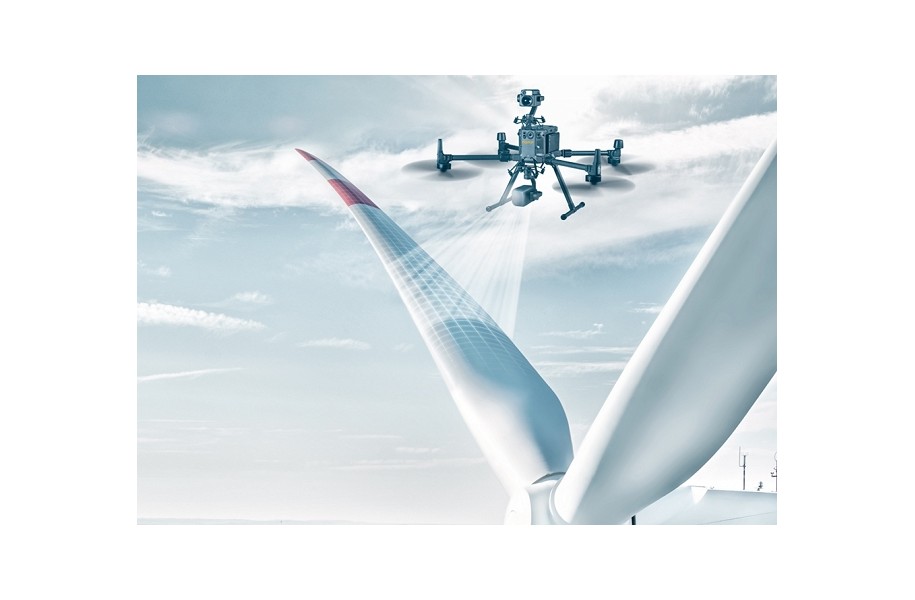
The drone non-contactly feeds an electromagnetic field into the lightning protection system and measures it with an integrated 3D field sensor. The flight is performed automatically; a short briefing is sufficient, specialized pilots are not required. Result: faster, more cost-effective, more reliable check.

Defect Localization – Automatic and Pinpoint Accurate
A signal generator couples HF signals at the blade root area. If the field is too weak or missing at the blade tip, there is an interruption. The drone autonomously scans the blade, determines the break-off point of the field, and logs the location with exact position data. Repairs can thus be checked immediately, and developments can be trended over subsequent flights.
TÜV Validation as an Alternative Method
TÜV SÜD has confirmed the measurement system as an alternative testing method according to the BWE Guideline – for the section of the lightning protection system from the receptors to the blade flanges of the rotor blades.

Practical Benefits for Operators
Less downtime and external dependencies, plannable costs, fast repeat tests, reliable documentation, and higher system safety – especially for large wind farms with tightly scheduled service windows.
Conclusion
Standard-compliant lightning protection tests remain mandatory. The autonomous, non-contact drone procedure brings speed, scalability, and documentation security – without the typical bottlenecks of classic inspections.
Are you interested in this topic? Check it out!